Monday, July 11, 2011

Yo-yo

The legend of the Yo-yo says that hundreds of years ago, it was used as a weapon. Who would ever thought that this toy was a weapon before? But it doesn't stop there, because the guys who were said to use this as a weapon was...us Pinoys! Imagine Filipino warriors screaming while attacking with spinning yo-yos in their hands, with one doing a walking-the-dog trick to smash the foot of his opponent. Funny stuff isn't it?

Well, it shouldn't be really making much of a difference if it was used as a weapon before. After all, the history of the yo-yo dates back even to the Egyptians, so we can't own the origins of it. But what we know for sure is that it was a Filipino who made the mass popularity of the toy possible. It was Pedro Flores, an Ilocano immigrant to the United States, that started this worldwide craze and led to innovations of the yo-yo. He became rich at the time of recession in the US. Talk about ingenuity.

But enough of this Pedro guy. Here's a video of how the world would look if a yo-yo is still being used as a weapon...


Sunday, July 3, 2011

The Anahaw

Who ever thought of making this plant the National Leaf of the Philippines has got to be joking! Even the people who was convinced must be crazy. What merits does this plant have to become a nation's symbol?

Honestly, there is nothing significantly historical or distinct about the plant. Nothing really special about the plant since it grows also in other regions of Asia. As of the moment, no wow scientific discoveries about the plant like cure for cancer, or AIDS or help in stem cell research. So why is the Anahaw a National Symbol?!?

Perhaps it is because it is a symbol of resourcefulness for us Filipinos. Why? Making something extraordinary out of an ordinary thing is distinct. This plant could probably be ignored or treated as an ornamental only. But no, we made it a part of our lives. 

We made so many things out of something common. Our ancestors has been using the Anahaw as part of our shelters as the roof and sometimes the walls. The leaf has been used as pambalot (food wrapper) for tikoy, or as a makeshift lunchbox for children going to school since lunchboxes were very expensive before. 

It has been made into Abaniko (fan), which is very beautiful and a work of art. A relief on a crowded place, or simply a refreshment from a hot, humid day, the colorful abaniko is an indispensable item in a Pinoy's everyday life.

Its really not about the object itself. That's why its called symbol. Its what the object symbolizes. And for the leaf, it symbolizes our ingenuity and resourcefulness.


Saturday, June 25, 2011

Ang Supremo

Andres Bonifacio, a-tapang a-tao...

When I was a kid, this was a popular rhyme with a naughty ending. One of the bravest, the most aggressive, and the most ambitious of the Filipino heroes, the Supremo was one of the founding members of the Kataastaasang, Kagalang-galangang Katipunan ng mga Anak ng Bayan. Later on, the Katipunan led the "premature" armed revolt which sparked the independence of our country.

Married twice after the loss of his first wife to leprosy, he never had any direct descendants. From accounts of historians, he wasn't a prestigious military leader but was a great tactician. He was never really good at politics but he could rally people with his passion and his love for his countrymen and country. Too bad because he was beaten to the presidency of the Philippines and was "executed" for crimes of treason against a "government" which his Katipunan created and nullified on a council session. I'd say he was assassinated, to which many historians agree.

Ka Andres by Jebbie Barrios
Still, no matter how bitter Andres' end was, his accomplishments are just too great to ignore. Even though Jose Rizal did not give blessing to him (did Andres really needed that?), probably because of lack of plan to fully execute a successful revolution, he was the first to rally the thousands who are willing to die for freedom. We went to war anyway, and although he initiated, he didn't expect things to go as they did. But the important thing is he rose to the occasion. Acts of violence is a last resort, during the time of Bonifacio, the choices are to wait, get abused and raped, or stand-up and fight. He said we must choose to fight. And we won our freedom.


Sunday, June 19, 2011

The Sarimanok

My first encounter with this legendary bird wasn't very overwhelming. The Sarimanok appears on the station ID of a local TV station in the Philippines back in the late 90's which one can probably see at least twice a day. It became just a nice bird with lots of colors. It doesn't seem very special, and it looks like a rooster.

But then again, the bird is very symbolical.

It means wealth and prosperity to the Maranaos. Tracing its roots to Islam due to the involvement of Muhammad in this, it is of no surprise that its popularity is widely accepted in the southern parts of the country. The Maranao legend says of a sultan's daughter being swept by a colorful rooster that turned to a dashing, handsome young man and the two was never seen ever again. The sultan then created visual replicas of the bird so that she can remember her daughter through it. Maybe he finds it easier to remember the chicken, rather than her daughter.

It is surprising that we Filipinos have a legendary bird too, just like the Phoenix. It is through the nature of its appearance that it probably got its name. Sari means cloth or garment, which is generally full of colors and  Manok (you should go back to being a baby if you're Filipino and don't know what manok is). The Sarimanok  is a colorful chicken indeed.


Saturday, June 11, 2011

Araw ng Kalayaan

The only reason why I am aware of this day is because its after a due date of a payment I have to make. Seriously, is anyone still looking forward to Independence Day? 

I did. That was the time when Independence Day, Will Smith and aliens means the same. 


Treaty of Paris 1898

Declaration of Independence is real, it just wasn't quite valid! Spain just passed the reigns to the United States and a mock-up battle in Manila Bay was staged just to show an event. Twenty Million Dollars. That's how much Philippines was worth in 1898. But of course that doesn't spell any difference to a country under colonization for 400 years. We were just glad it was all over...or so we thought.

Still more years of struggle came against a different colonial nation. But yes, eventually we did get our "independence."

Quite colorful isn't it? Still Araw ng Kalayaan is worth remembering. In memory of the fallen warrior heroes who fought and sacrificed, in their passion and vision for their children to have freedom. For their burning desire to liberate, and playing a game of chance with fate, we owe them commemoration. But since its not National Heroes Day, I think it is also proper to give gratitude to the politicians who used politics for us to finally gain freedom. Team effort, I suppose.


Sunday, May 29, 2011

Blood Compact

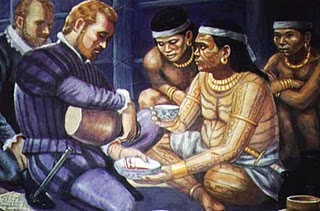
Spaniards call this "Pacto de Sangre." It sounds morbid and makes Filipinos of old look like blood thirsty natives. Maybe our ancestors were vampires, but of course they're not. Don't think they want to taste the blood of men from a different race. For them, blood is sacred.

Blood is life. To sign an agreement with blood is to sign with one's life. It becomes a bond to protect and honor the agreement with one's life. To enter into a blood compact is to enter to a lifetime oath. The bad thing about this is, if one dies, the deal is off.

Other cultures have seriously misunderstood this practice. It is not drawing blood and drinking it straight up. At least we use glasses for it, while the vampires suck from the body directly. The blood compact is not barbaric since they mix it in wine and its only a couple of drops of blood. Seriously, what would a couple of drops of blood do to you in an alcoholic drink?

On the latter part of the colonial history of Spain, almost the same thing happened with the Katipuneros. Signing also with blood. But of course since there were thousands of Katipuneros, it will be like a blood party. That would be a taboo. Instead, these men signed their membership forms with their own blood as ink. Very creative, really.

We lost our independence through a pact of blood. We gained it back through a pact of blood. Blood is really important for us Filipinos. Blood and sweat.

"Dugo at pawis ipinuhunan ko dyan." It means "I toiled and sacrificed myself for it" and when we Pinoys say that, it means we are not going to let things go easily.


Friday, May 6, 2011

Para kay Nanay

Ang ilaw ng tahanan. Ang Ina. 


For a long time I wondered why nanays are called ilaw ng tahanan? No one could really answer why. It was a regal way of giving tribute to our mothers, but what if it was a big joke? In the past lanterns and incandescent light bulbs were very popular. Perhaps some guy drinking tuba with friends stared at a lantern called up to one of his buddies and said "Uy pare tignan mo yung lampara, kahugis ng katawan ng misis mo,"and everyone laughs. Or maybe the term hugis bumbilyang asawa gave way to the "ilaw ng tahanan" thing. We could never really know, but it sounds really cool to be called ilaw.


From the word ina, came nanay, inay, inang, and so many others. In the days of old before colonial mentality took over, mothers are revered and respected. They receive lots of respect because of the sacrifices a mother give just to be a good nanay. Mothers indeed took care of us, from conception till one is able. To mould a child is one of the biggest tasks a mother has in her hands. Of what kind of adult a child turns out, a mother has a big influence on that.

We cry to her. We call her when we are weak. We all look up to her and admire her grace, her strength and her love. It is from her that we all learn our many firsts. It is her that we love to pester, but as children, that is our lambing and she understands.

Her arms are the the very cradle of love, support and protection. It is she that awakens the warrior within, who says things are worth fighting for. She who says while she is strong, she will take care of you unconditionally. She who willingly would sacrifice anything for her child.

This is a tribute to all mothers. We celebrate Mother's Day, we celebrate womanhood. To all mothers, isang pagpupugay sa inyong sakripisyo, pag-aalaga at pagmamahal. 

Here's something to touch your hearts this Mother's Day.