Saturday, June 25, 2011

Ang Supremo

Andres Bonifacio, a-tapang a-tao...

When I was a kid, this was a popular rhyme with a naughty ending. One of the bravest, the most aggressive, and the most ambitious of the Filipino heroes, the Supremo was one of the founding members of the Kataastaasang, Kagalang-galangang Katipunan ng mga Anak ng Bayan. Later on, the Katipunan led the "premature" armed revolt which sparked the independence of our country.

Married twice after the loss of his first wife to leprosy, he never had any direct descendants. From accounts of historians, he wasn't a prestigious military leader but was a great tactician. He was never really good at politics but he could rally people with his passion and his love for his countrymen and country. Too bad because he was beaten to the presidency of the Philippines and was "executed" for crimes of treason against a "government" which his Katipunan created and nullified on a council session. I'd say he was assassinated, to which many historians agree.

Ka Andres by Jebbie Barrios
Still, no matter how bitter Andres' end was, his accomplishments are just too great to ignore. Even though Jose Rizal did not give blessing to him (did Andres really needed that?), probably because of lack of plan to fully execute a successful revolution, he was the first to rally the thousands who are willing to die for freedom. We went to war anyway, and although he initiated, he didn't expect things to go as they did. But the important thing is he rose to the occasion. Acts of violence is a last resort, during the time of Bonifacio, the choices are to wait, get abused and raped, or stand-up and fight. He said we must choose to fight. And we won our freedom.


Sunday, June 19, 2011

The Sarimanok

My first encounter with this legendary bird wasn't very overwhelming. The Sarimanok appears on the station ID of a local TV station in the Philippines back in the late 90's which one can probably see at least twice a day. It became just a nice bird with lots of colors. It doesn't seem very special, and it looks like a rooster.

But then again, the bird is very symbolical.

It means wealth and prosperity to the Maranaos. Tracing its roots to Islam due to the involvement of Muhammad in this, it is of no surprise that its popularity is widely accepted in the southern parts of the country. The Maranao legend says of a sultan's daughter being swept by a colorful rooster that turned to a dashing, handsome young man and the two was never seen ever again. The sultan then created visual replicas of the bird so that she can remember her daughter through it. Maybe he finds it easier to remember the chicken, rather than her daughter.

It is surprising that we Filipinos have a legendary bird too, just like the Phoenix. It is through the nature of its appearance that it probably got its name. Sari means cloth or garment, which is generally full of colors and  Manok (you should go back to being a baby if you're Filipino and don't know what manok is). The Sarimanok  is a colorful chicken indeed.


Saturday, June 11, 2011

Araw ng Kalayaan

The only reason why I am aware of this day is because its after a due date of a payment I have to make. Seriously, is anyone still looking forward to Independence Day? 

I did. That was the time when Independence Day, Will Smith and aliens means the same. 


Treaty of Paris 1898

Declaration of Independence is real, it just wasn't quite valid! Spain just passed the reigns to the United States and a mock-up battle in Manila Bay was staged just to show an event. Twenty Million Dollars. That's how much Philippines was worth in 1898. But of course that doesn't spell any difference to a country under colonization for 400 years. We were just glad it was all over...or so we thought.

Still more years of struggle came against a different colonial nation. But yes, eventually we did get our "independence."

Quite colorful isn't it? Still Araw ng Kalayaan is worth remembering. In memory of the fallen warrior heroes who fought and sacrificed, in their passion and vision for their children to have freedom. For their burning desire to liberate, and playing a game of chance with fate, we owe them commemoration. But since its not National Heroes Day, I think it is also proper to give gratitude to the politicians who used politics for us to finally gain freedom. Team effort, I suppose.


Sunday, May 29, 2011

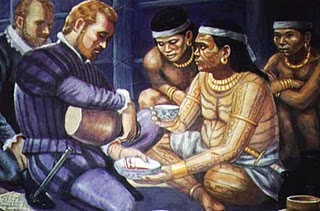
Blood Compact

Spaniards call this "Pacto de Sangre." It sounds morbid and makes Filipinos of old look like blood thirsty natives. Maybe our ancestors were vampires, but of course they're not. Don't think they want to taste the blood of men from a different race. For them, blood is sacred.

Blood is life. To sign an agreement with blood is to sign with one's life. It becomes a bond to protect and honor the agreement with one's life. To enter into a blood compact is to enter to a lifetime oath. The bad thing about this is, if one dies, the deal is off.

Other cultures have seriously misunderstood this practice. It is not drawing blood and drinking it straight up. At least we use glasses for it, while the vampires suck from the body directly. The blood compact is not barbaric since they mix it in wine and its only a couple of drops of blood. Seriously, what would a couple of drops of blood do to you in an alcoholic drink?

On the latter part of the colonial history of Spain, almost the same thing happened with the Katipuneros. Signing also with blood. But of course since there were thousands of Katipuneros, it will be like a blood party. That would be a taboo. Instead, these men signed their membership forms with their own blood as ink. Very creative, really.

We lost our independence through a pact of blood. We gained it back through a pact of blood. Blood is really important for us Filipinos. Blood and sweat.

"Dugo at pawis ipinuhunan ko dyan." It means "I toiled and sacrificed myself for it" and when we Pinoys say that, it means we are not going to let things go easily.


Friday, May 6, 2011

Para kay Nanay

Ang ilaw ng tahanan. Ang Ina. 


For a long time I wondered why nanays are called ilaw ng tahanan? No one could really answer why. It was a regal way of giving tribute to our mothers, but what if it was a big joke? In the past lanterns and incandescent light bulbs were very popular. Perhaps some guy drinking tuba with friends stared at a lantern called up to one of his buddies and said "Uy pare tignan mo yung lampara, kahugis ng katawan ng misis mo,"and everyone laughs. Or maybe the term hugis bumbilyang asawa gave way to the "ilaw ng tahanan" thing. We could never really know, but it sounds really cool to be called ilaw.


From the word ina, came nanay, inay, inang, and so many others. In the days of old before colonial mentality took over, mothers are revered and respected. They receive lots of respect because of the sacrifices a mother give just to be a good nanay. Mothers indeed took care of us, from conception till one is able. To mould a child is one of the biggest tasks a mother has in her hands. Of what kind of adult a child turns out, a mother has a big influence on that.

We cry to her. We call her when we are weak. We all look up to her and admire her grace, her strength and her love. It is from her that we all learn our many firsts. It is her that we love to pester, but as children, that is our lambing and she understands.

Her arms are the the very cradle of love, support and protection. It is she that awakens the warrior within, who says things are worth fighting for. She who says while she is strong, she will take care of you unconditionally. She who willingly would sacrifice anything for her child.

This is a tribute to all mothers. We celebrate Mother's Day, we celebrate womanhood. To all mothers, isang pagpupugay sa inyong sakripisyo, pag-aalaga at pagmamahal. 

Here's something to touch your hearts this Mother's Day.


Saturday, April 30, 2011

Manggagawang Pinoy

Our country will always be a nation of the working class. Throughout history, the fate of the Philippines depend on the masa. Well, actually, the truth is the fate depends on who could muster and mobilize the working class.

Spanish occupation. Our farmers and laborers said enough. An uprising of sticks and bolos ensued, we got our independence.

EDSA. The working class said enough, and the most important road in the country filled with people. A dictator got ousted...peacefully.

It is the working class who make a country move, a business run, a home built, make clothes to be worn. It is the working class who should be protected, loved and esteemed. It is in the working class that the survival of a family, the survival of the future generation depend on.
'
If the country depends on them greatly then why are they rewarded poorly? Why OFWs say kung sa Pinas ako maghahanapbuhay, magugutom ang pamilya ko." There is something wrong. It has been wrong for a long time already. Generations of leaders have gone and passed, many still say they are poor. Although others say mayaman ako sa utang.

May 1, Labor Day. In honor and celebration of the Manggagawang Pinoy, and then everyone else forgets almost immediately. A sad amnesia.

This is a tribute to the Filipino Workers, both here and abroad. Each is a warrior fighting for a living, for the survival of their families. Too bad, Labor Day of 2011 comes on a Sunday...no holiday.


Thursday, April 21, 2011

The Bulacan Visita Iglesia

The province of Bulacan, home of many old churches and a lot of history. This is became the destination of my Visita Iglesia for 2011. The Visita Iglesia or church visit, goes way back when the early Christians visit the 7 great basilicas in Rome for the adoration of the blessed sacrament. For convenience, usually one goes to churches within the immediate vicinities. This is my attempt to go out of convenience.


First stop, the Barasoain Church in Malolos. This church housed the first Philippine Republic and the site of the Constitutional Convention. It is a popular tourist destination, and one of the most beautiful churches in the province.


The second church on the list is the Santiago de Apostol in Paombong, Bulacan or St. James and it was along the way to Brgy. Kapitangan, Paombong. The attempt to go to the Bisita(chapel) at Kapitangan was cut short because of the narrow roads and no parking space. This is where the Hampas Dugo are and a reenactment of the crucifixion takes place. Unfortunately, these penitents all go out during Good Friday.


So after abandoning the search for the Hampas Dugo penitents, Hagonoy is next where the National Shrine for St. Anne stood. This century-old church is the only place in the Philippines where the relics of St. Anne and St. Joachim, parents of the blessed Virgin Mary, are kept.


Here is a shot of the beautiful interior of the Shrine of St. Anne. The ceiling is made of real wood and the local artisan's artworks are impressive.


After the shrine, we head back to a church we skipped. The seat of the Diocese of Malolos, The Basilica Minore of the Immaculate Concepcion. Located at the center of Malolos, this was the seat of executive power of Emilio Aguinaldo for a few years.


Sta. Isabel was the next stop. Partially hidden from the high volume roads of Malolos and not as big as Barasoain and the Basilica, this church boasts of a greener patio and courtyard.


A view of the interior of Sta. Isabel.
After Sta. Isabel, the next stop was Sta. Rita de Cascia. It wasn't a church that might get awarded with heritage benefits, but the church is known for its unique design during the Holy Week. Arriving at the church, the design is still being put up, yet in its assembly stage, it already looks good. I skipped the part of taking photos of this church, since its setup wasn't completely done yet.


The seventh stop of the Visita Iglesia ended in the oldest church in Plaridel, the Santiago de Apostol. According to records, this church had stood for 400 years.


Altar of Santiago de Apostol in Plaridel